Modernist Bridal Tiaras and Crowns — A New Aesthetic for the Ceremony |
← |
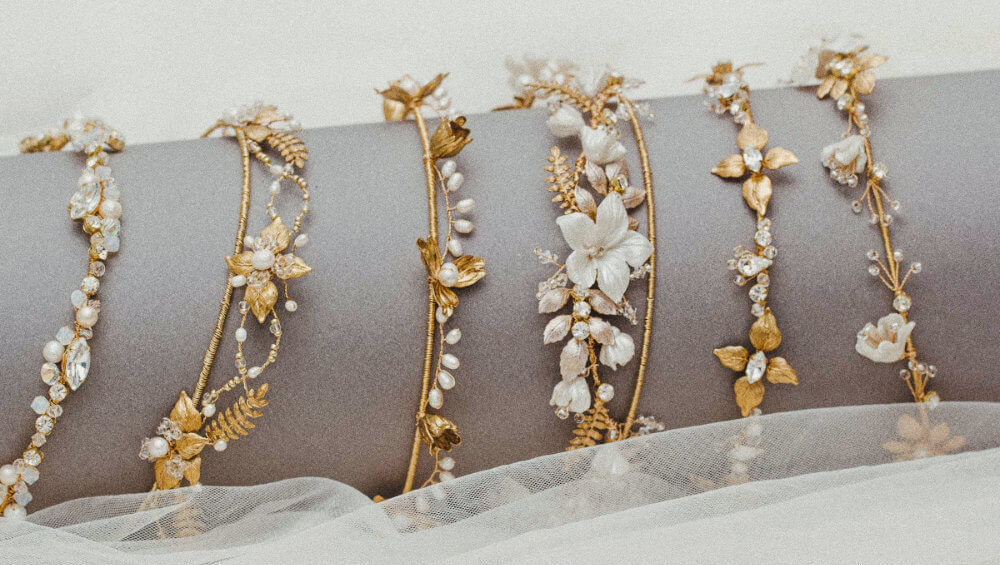
The classic tiara is a legacy of the court — symmetry, crystals, gold in geometric order. The modernist tiara is something different: a form that grows from nature rather than from protocol. Irregular, organic, light. Worn not as a symbol of status, but as a considered aesthetic choice.
The shift we are seeing in bridal jewelry is not simply a matter of fashion. It is a more fundamental correction: brides have stopped asking "what is appropriate" and started asking "what is mine." Hair accessories have moved in the same direction. Interest in the classic crystal tiara is declining. Interest in organic, botanical and sculptural forms is growing — forms that look as though they grew from the head rather than being placed upon it.
At the Nelrosa atelier, we design and make modernist bridal tiaras and crowns by hand — from gold-plated wire, silk flowers, freshwater pearls and Preciosa crystals. This article is a guide to the aesthetic we represent: where it comes from, what distinguishes it, and how to wear it.
A modernist tiara is not a response to the classical one — it is a question asked from the beginning. The classical tiara organises materials around symmetry and brilliance. The modernist tiara organises them around form and narrative. The difference is immediately visible: one looks like a jewel placed on the head, the other looks like part of the hairstyle.
A working definition: a modernist bridal tiara or crown is a hair accessory in which form is primary to decoration. The silhouette does not exist to "hold" more stones or flowers — the silhouette is the statement. The line of the wire, the asymmetry of the leaves, the density of pearls concentrated in one place and the deliberate negative space in another — all of these are design decisions, not accidents.
ASYMMETRY AS PRINCIPLE
The classical tiara is a mirror image of itself. The modernist tiara may concentrate its elements on one side and open into negative space on the other. Asymmetry in bridal jewelry is not an error — it is a choice that communicates something about the woman who wears it. In the Nelrosa collection, most models are deliberately non-symmetrical: the botanical arrangement of leaves and flowers is denser on one side, sparser on the other.
ORGANIC MATERIAL
Silk, freshwater pearl, gold wire shaped by hand — materials that have their own texture and behaviour. A silk flower formed petal by petal is not identical to any other silk flower. A freshwater pearl is not round like a bead. These "imperfections" are the source of value, not an argument against.
PHYSICAL LIGHTNESS
A modernist tiara can be visually complex and physically light simultaneously. Gold-plated wire as a base — continuous, springy, adapting to the shape of the head — allows elaborate forms to be built without burdening the wearer. Nelrosa accessories are measured in grams, not tens of grams. You wear them for the full length of a wedding day and cease to notice they are there.
INTEGRATION WITH THE HAIRSTYLE
A modernist tiara does not rest on the hairstyle — it enters into dialogue with it. A vine wrapping an updo, a headband absorbed into sleek hair, a halo hovering above curls — in each case the accessory and the hairstyle together form a composition, rather than competing with one another. This requires precision in both the design of the piece and the planning of the hairstyle.
Organic hair jewelry is not a recent invention. Wreaths of living flowers reach back to antiquity. Gold leaves as head adornment — ancient Greece and Rome. Renaissance tiaras with enamel and precious stones were built around botanical motifs. Art Nouveau at the turn of the nineteenth and twentieth centuries — Lalique, Fouquet, Vever — defined jewelry as organic sculpture: insects, flowers, branches in ivory and enamelled gold.
The modernism of the twentieth century pushed the organic form aside. Hollywood crystal tiaras, geometric diamond diadems — symmetry and brilliance prevailed. The return of organic form in bridal jewelry over recent decades is not nostalgia: it is the continuation of an interrupted thread.
The contemporary modernist tiara brings together two traditions: the organic aesthetic of Art Nouveau and the minimalism and light structure made possible by current techniques for working wire and silk. This is not a "floral tiara." It is a sculptural form whose materials happen to be gold, silk and pearl.
"A tiara that looks as though it grew from the head — that is the highest level of bridal accessory design. Nothing in it is accidental: not the asymmetry, not the density, not the lightness. Every decision is an intention."
The Nelrosa collection encompasses three distinct aesthetics — each corresponding to a different character of bride and a different style of wedding. These are not price categories, nor degrees of ornamentation. They are three separate visual languages.
Botanical aesthetic — gold leaves in varied sizes, silk flowers in white or ivory, freshwater pearls as fill between the botanical elements. The form recalls a wreath of fresh flowers, but made from materials that will last decades. Hairstyles: updo, loose waves, hair vine arrangements. Gowns: lace, organza, textured fabric. Weddings: garden, outdoor, industrial loft.
Floral maximalist aesthetic — a headband with large silk flowers as the dominant element. A form that is clear, structural and visible from a distance. Flowers hand-formed from multiple layers of silk — each petal separate, each flower different. This aesthetic is for the bride who is not afraid of being noticed. Hairstyles: sleek updo, centre parting, low chignon. Gowns: plain satin or crepe — the gown must be quiet so that the accessory can speak.
Geometric / halo aesthetic — a double or triple hoop set with small freshwater pearls. A minimal form, a maximum effect. The halo band hovers above the head like an architectural element — visible from every angle, simple in form, complex in reception. This aesthetic is for the bride who understands that less can say more. Hairstyles: high updo, bun, sleek pulled-back hair. Gowns: minimalist, structural.
The position of a tiara on the head changes everything — not only aesthetically, but technically. A crown placed high elongates the silhouette and gives a ceremonial quality. A headband positioned closer to the hairline produces a more relaxed effect. A vine arranged from temple to temple frames the face without dominating the hairstyle.
Securing is as important as the form. The gold wire of a Nelrosa piece is pliable and can be shaped during a fitting — literally adjusted to the specific shape of a person's head. Bobby pins in the same colour as the wire remain invisible. On smooth or fine hair, a stylist should create a foundation for the pins (a backcombed section or a small braid) before placing the accessory.
One general rule: the tiara should sit firmly at home before you leave. If it is "moving slightly" — it is under-secured, not "secure enough." There is no opportunity to adjust it during the ceremony.
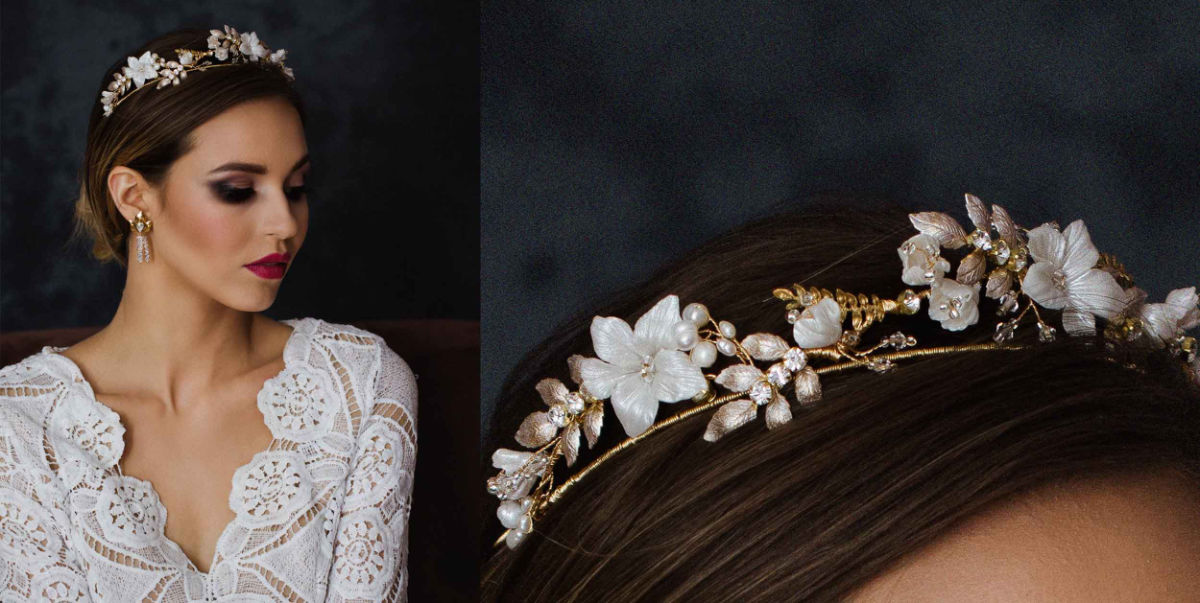
This question appears in every consultation. The answer depends on sequence: the veil goes on and comes off; the tiara stays. The tiara should therefore sit independently of the veil — it should not be pinned to it or rely on it for support.
Cathedral or chapel veil — tiara at the front of the head, veil secured behind the tiara or to one side. Fingertip veil — the tiara as the primary accessory, the veil discreet. Blusher (veil covering the face) — the tiara must be visible above the blusher, which rules out very fine vine forms worn low on the head.
Many stylists recommend removing the veil after the ceremony and replacing it with additional pins or a smaller vine. The headband or crown remains — and becomes the sole hair accessory for the reception. It is an elegant transformation without changing the jewelry.
Gold in bridal jewelry is not one colour. Yellow gold — warm, saturated, clear. Rose gold — quieter, more delicate, prevalent in recent years. Antique gold / brushed gold — matte, aged, suited to vintage and bohemian aesthetics.
Nelrosa headbands and tiaras are made on gold-plated wire in a warm, deep tone — closer to antique gold than to polished yellow. This tone does not compete with the skin or with the white of the gown — it settles into them. This is a conscious decision: we want the accessory to look like part of the hairstyle, not like jewelry resting on top of it.
For ivory or champagne gowns — warm gold works better than cool silver. For pure white gowns — both metals are possible, depending on the overall mood.
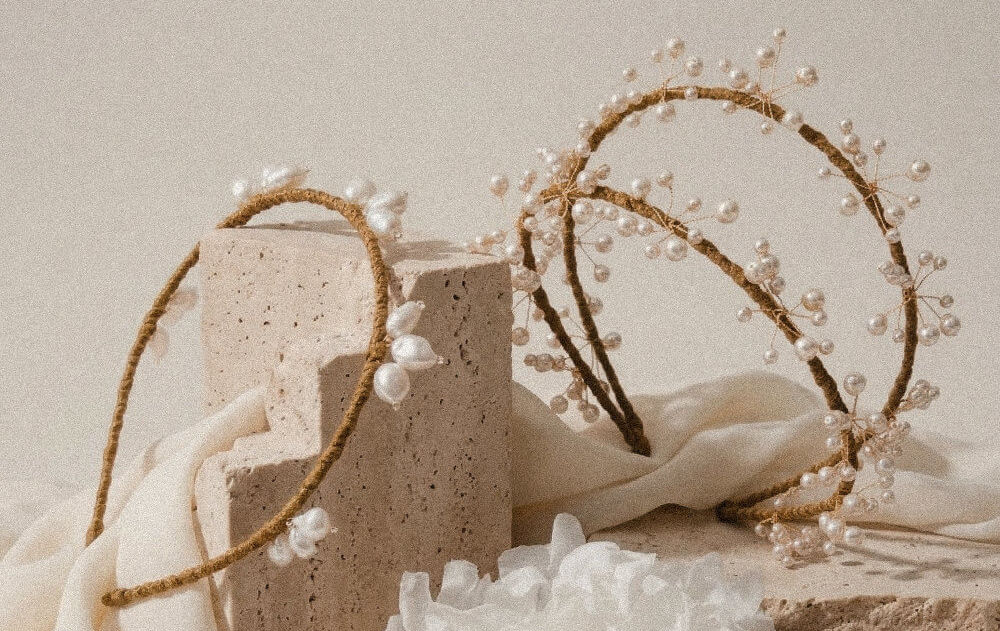
A Nelrosa bridal hair accessory is made from durable materials — natural silk, freshwater pearl, gold-plated wire — and with appropriate care will retain its appearance for decades. It is not a disposable object.
Several possibilities for the tiara's second life: as an accessory for evening occasions. As a domestic object — on a wooden branch, on a mirror frame, in a glass cabinet. As a family piece to be passed on — the tiara you wore at your wedding may one day be worn by someone who comes after you.
We call this Modern Heirloom. You are not buying an accessory for one day. You are acquiring an object that will carry a story.
Every model in the Nelrosa collection can be ordered with a small number of adjustments, individual modifications — without changing the design of the form. Within each model there are choices that genuinely affect the final result.
| ↑ | ← |
nature inspired handcrafted
We’re a small Poland-based jewelry brand, where lucid and classic designs meet unique details. Our handcrafted pieces are tailored to empower the everyday woman with modern feminine energy. Explore our collection and find the perfect jewelry to celebrate your unique live story.
As always, it is made with love to You.